
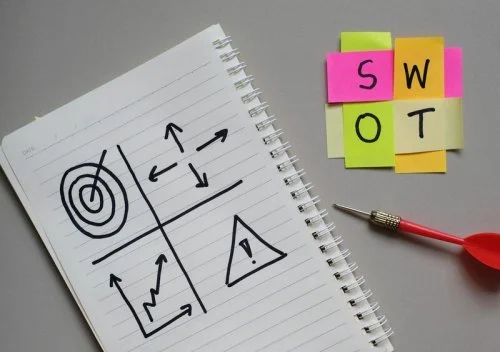
SWOT analysis is an essential part of every successful business. What is this analysis used for, how does it work, and why is it important to create one?
What is a SWOT analysis?
Wondering what SWOT stands for? The name of this analytical technique comes from four English words: Strengths, Weaknesses, Opportunities, Threats. That covers where the name comes from, but what is it really about? SWOT analysis is very often used to assess the internal and external factors that may affect a company's success. You will most often encounter it in strategic management and marketing. What is the goal of a SWOT analysis? Above all, to identify and then reduce weaknesses, build on strengths, look for new opportunities and become aware of threats.

Internal and external factors
What do internal and external factors actually mean? Internal factors come from the internal environment, that is, whatever can affect your business from within the company. These include, for example, company relationships, products, work organization, production capacity, logistics and the like. External factors, by contrast, act on your company from the outside and cannot be influenced. We are talking about material supplies, changes in interest rates, energy prices or the phase of the economic cycle.
Not every quadrant is the same
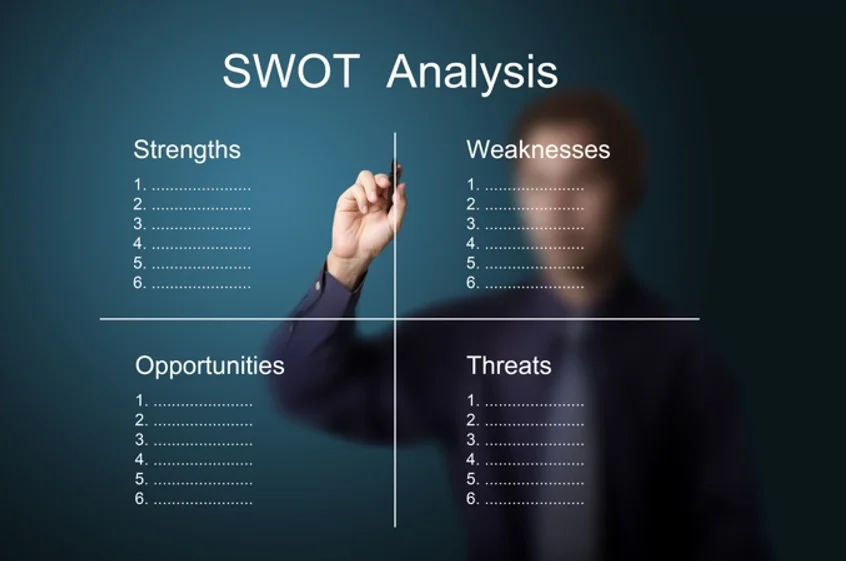
If you want to get started on a SWOT analysis, you should know how to go about it. So grab a pencil and let's get to it. The analysis consists of four quadrants, which you need to draw before you can move on to the next step. The left half contains positive factors and the right half negative ones. If we divide the grid into an upper and a lower part, we find that internal factors are at the top and external factors at the bottom.
To complete the description of the matrix, it is important to know that:
- the top-left quadrant contains strengths (Strengths)
- in the top-right quadrant you will find weaknesses (Weaknesses)
- the bottom-left quadrant holds opportunities (Opportunities)
- in the bottom-right quadrant, threats loom (Threats)
Once you are clear on the layout of the quadrants, you can start listing items. To make the analysis as effective as possible, it is recommended to come up with at least five items for each quadrant. However, the more detailed the analysis, the better for your business.
How to fill in a SWOT analysis
Enough delay, let's get down to business! The quadrants are clear, but filling in the analysis with the first things that come to mind, without much thought, is a road to ruin. A SWOT analysis has certain procedures and requirements to follow so that it brings you the greatest possible benefit. Let's go through these rules:
- Focus on the key facts and let the insignificant ones fade into oblivion.
- Leave assumptions and speculation aside. Enter only facts in the quadrants, that is, only measurable things.
- Work on it as a team and hear everyone's opinion. Write down only the things that the vast majority of you agree on. Other points do not carry enough weight.
Time to evaluate!
Once you have filled in all the quadrants as carefully as possible, you can start the evaluation. And not just any evaluation. Dive into the individual quadrants again and assess one against another using the following types of evaluation:
- S-O evaluation: Strengths vs. opportunities, or how to use your company's strengths to seize the opportunities the market offers you.
- W-O evaluation: Weaknesses vs. opportunities. Determine how opportunities can help you eliminate weaknesses.
- S-T evaluation: Strengths vs. threats shows how to use strengths to avert threats.
- W-T evaluation: Weaknesses vs. threats shows how to reduce threats in relation to our weaknesses.
Future benefits
We now know how to put the analysis together and how to fill it in properly, but let's also look at what benefits it will bring you in the future. By clarifying your strengths, you have something the company can benefit from greatly and build its business on. If you locate your weaknesses, you will know where there is room for improvement and can focus on it in your future development. By defining opportunities, you will find out how to make use of what the market offers and which direction you can take in the future. And if you identify threats, you know what to watch out for, what to avoid and what to guard against so that it does not endanger the running of your company.